 Do we reap what we sow? Do we get what we deserve when we die?
Hinduism, Jainism, Buddhism and Sikhism, India’s contribution to the world, teach that our thoughts and actions have consequences, namely rewards or punishments. Goodness leads to rewards and bad thoughts and actions lead to pain and suffering. This, in a nutshell, is Karma.
On the other end of the religious spectrum is Historic Christianity that teaches the virtual opposite – Grace. The dictionary definition of grace is mercy, clemency or pardon.
A brief study of Grace and Karma is invaluable to those on either side as well as the honest seeker. Karma and Grace gain utmost significance because they are two fundamental and uncompromising doctrines within their respective worldviews. Christians and Hindus would never compromise the doctrines of Grace and Karma, respectively.
KARMA
Karma means action, “Karma in Hinduism (Sanatana dharma) is considered to be a spiritually originated law that governs all life. In the Law of Karma even though an individual is considered to be the sole doer and enjoyer of his Karmas and their ‘fruits’, according to Vedanta, the supreme being (The Divine) plays a major role as the dispenser of the ‘fruits’ of Karma…”1
The following is a listing of the basic facets of Karma:2
1. The Hindu Scriptures, Uphanishads, Bhagavadgita and the Puranas, teach Karma.
2. Karma applies to human beings, plants, animals and microorganisms. Karma also applies to groups such as associations, organizations and nations; this is termed as the collective karma.
3. Karma does not apply to God. But gods and celestial beings are bound by the law of Karma. (According to some Puranas, Brahma, Vishnu and Siva attained their position of divine responsibilities because of their meritorious actions in their previous births.)
4. Sin, according to Hinduism, is an offense committed against human beings and not God.
5. Karma includes both the physical and the mental actions (thoughts). Man possesses free will to perform a good action, a good word or a good thought, and these would fetch him/her rewards. Anything bad would fetch punishment. (Karma includes even our most natural acts such as sleeping and breathing, hence non-action and deliberate inaction is also a part of karma.)
6. Hinduism recognizes four types of karma:
6.1 Sanchita Karma: It is sum total of the accumulated karma of previous lives.
6.2 Prarabdha Karma: That part of the sanchita karma that is currently activated in the present life and which influences the course of the present life.
6.3 Agami Karma (Future Karma): The karma that arises out of the current life activities, whose consequences will be experienced by the individual in the coming lives.
6.4 Kriyamana Karma: This is the karma whose consequences are experienced in this very life.
7. Reincarnation is a necessary aspect of karma. Karma binds its subjects to cycles of births and deaths by initiating the cycle of cause and effect. Rebirth would occur until there is balance in the individual’s karmic account. The soul cannot attain moksha (salvation) without exhausting the accumulated Karmas.
8. A soul could exist for even a million years to exhaust the accumulated karmas. Thus the individual soul carries the burden of its karma until a permanent liberation is achieved through the renunciation of the doership and detachment from the fruits of actions.
Hindus are obligated to perform certain duties to neutralize their karma. There are two mandatory karmas every Hindu ought to perform (it is sinful to not perform these duties) and there is an optional karma:
8.1 Nitya Karma includes duties every human being ought to perform (sleep, shower, eat, pray etc.).
8.2 Naimittika Karma includes duties that ought to be performed on specific occasions such as festivals, solar, lunar eclipses, marriage, funeral rites etc.
8.3 Kamyakarma includes optional duties such as going on a pilgrimage, educating one’s children, property purchase, performing a sacrificial rite etc.
Hinduism also teaches that since man can never develop the sense of being perfectly right or wrong, performing these duties need not necessarily incur merit. Hence spiritual means is necessary for a Hindu to be liberated from his/her karma, “Karma ends when you have perfected yourself in art of doing Karma without attachment. The ability to do Karma without attachment (without expectation of Karma-phala) can be attained by perfecting oneself on the path to the Divine by following various yogas – Karma yoga (yoga of action without attachment), Bhakti yoga (yoga of love for the Divine), Gyan yoga (yoga of knowledge and awareness), Siddha or Kundalini yoga (yoga of divine consciousness), Hatha yoga (purification of the body and mind through Asanas and Pranayama), Laya yoga (yoga of meditating on interior energy centers), Mantra yoga (yoga of Divine or Sacred words, phrases, or syllables) or any combination of these.”3 (Emphasis Mine).
GRACE
In the Hindu worldview there is an inexorable connection between man’s actions and consequences, not even death can break this connection, for the law of karma carries over into the next incarnation.
However, in the Christian worldview, the sin-punishment sequence can be interrupted by repentance and confession of sins, with consequent forgiveness, and death brings a release from the temporal effects of sin. God’s love and grace offer this privilege to the repentant man.
God does not deal with man based on man’s merit. God deals with man based on HIS own goodness and generosity. God also deals with man based on his nature and his need i.e. man’s nature is that he is innately sinful and his perpetual need is to be forgiven.
Grace means God’s goodness towards those who deserve only punishment. God supplies man with undeserved or unmerited favors i.e. HIS favor is toward those who deserve no favor but only punishment.
In other words, salvation is a [free] gift from God to man (Romans 6: 23; Ephesians 2: 8-9). Salvation, according to Historic Christianity, is by the grace of God (Ephesians 1: 5-8).The Bible also mentions God’s grace as an extravagant gift (Cf. Titus 2: 11, 3: 3-7).
Since God’s grace is unmerited, there is only one human attitude appropriate as an instrument for receiving God’s grace, namely, faith (Cf. Romans 4: 16). While it is faith that leads to man’s justification, justification must and will invariably produce works appropriate to the nature of the new creature4 that man has become (Ephesians 2: 8-9; James 2: 17).
The good news of Christianity is that God became man “full of grace and truth” (John 1: 14-17). God did not come in the form of Jesus Christ as a judge and executioner, for if HE had done so, entire mankind would have been found guilty and sentenced to everlasting punishment. But God became man to be gracious to us.
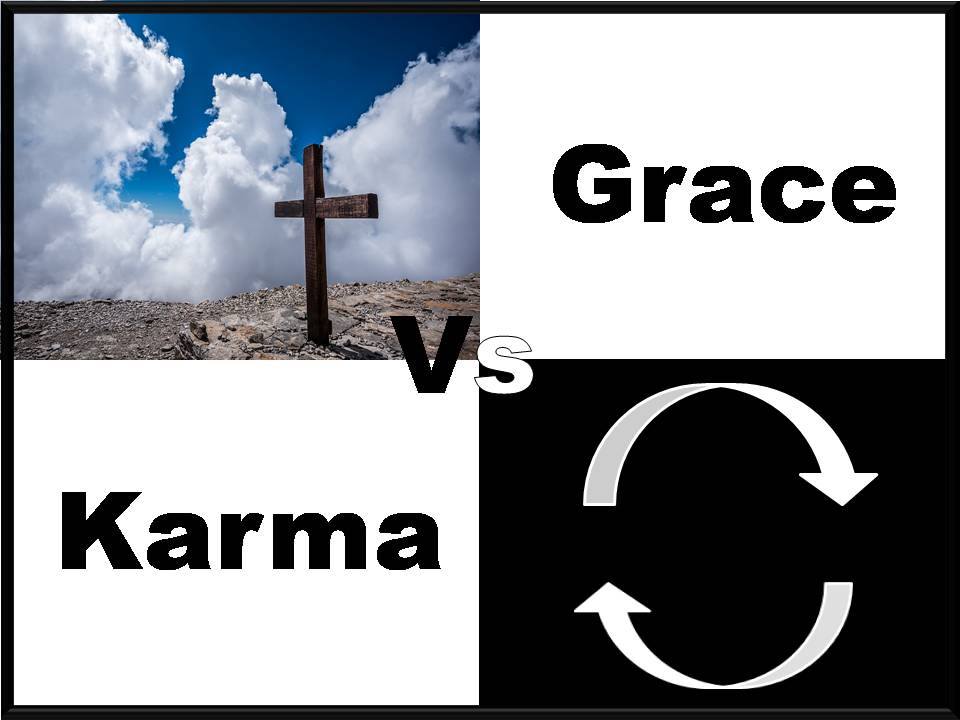
Hence, Christ died on the cross for the sake of man’s sins. The cross of Christ is a symbol of the fullness of God’s grace.
HARMONY
A few instances where Grace and Karma harmonize are:
1. Christianity deems man as sinful [from birth]. Hinduism, by virtue of the law of karma, believes that man would sin in thoughts, words and deeds.
2. Christianity and Hinduism emphasize the need for punishment of sins.
3. The Bible also mentions reaping and sowing (Job 4: 8, Psalm 126: 5). However, the act of receiving rewards for our good deeds is in this life and in our life in heaven (Matthew 16: 27; Revelation 22: 12).
DISSONANCE
The Bible diverges from karma in these aspects:
1. Every sin merits death and no amount of good works can override our bad thoughts, deeds or words, for man is innately sinful. Hence, man ought to receive God’s grace through repentance and faith in the Lord Jesus Christ.
2. Good works are an outcome of man’s trust and perpetual dependence upon Christ (Cf. Philippians 2: 13).
3. Outside of God’s love and forgiveness there is no hope for man. Because God loves the sinful man, HE has offered a provision for him to repent and turn to Christ, so that everyone who repents of his/her sins, declares that Christ is Lord and believes in his/her heart that God raised HIM from the dead will be saved.
ENDNOTES:
1http://www.thekundaliniyoga.org/karma/karma_gods_law_action_fruit_rebirth_reincarnation_hindu_perspective.aspx#Types of Karma, last accessed 2nd Feb 2017.
2http://www.hinduwebsite.com/hinduism/h_karma.asp, last accessed 2nd Feb 2017 & http://www.hinduwebsite.com/conceptofkarma.asp#fn02, last accessed 2nd Feb 2017.
3http://www.thekundaliniyoga.org/karma/karma_gods_law_action_fruit_rebirth_reincarnation_hindu_perspective.aspx#Types of Karma, last accessed 2nd Feb 2017.
4Man who trusts and remains in Christ becomes a new creation and will no longer live for himself (2 Corinthians 5: 17), man’s life will become spiritual.
